



3D Production Pipeline
October 29th, 2008
Pre-Production:
Concept Art & Story: the first step of any project begins with an idea.
- Writers devise a general story, translate it to script format, edit and storyboard it until perfection.
- A large production company (ie: Dreamworks) generally hires only 2 or 3 concept artists to guarantee a steady style throughout a project for characters, set and props.
 Activison’s Doom 3 (2004)
Production:
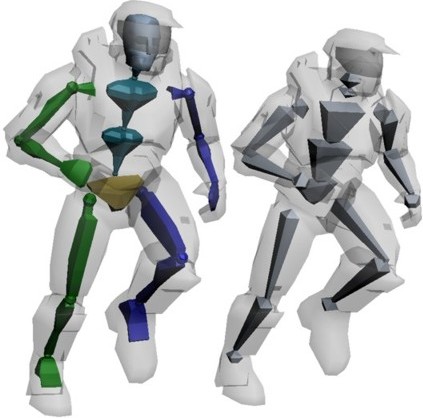
Master Chief Rig - Microsoft
Modeling: Editing and sewing shapes to compose 3D meshes of characters, props, sets etc.
Rigging: Adding a skeleton and control handles to the modeled meshes that allow animators to manipulate the models (one of the most tech-heavy jobs)
Texturing/Lighting: Giving color and surface to models through either painting in Photoshop or editing texture photographs. Lighting adds mood to a scene.
Animation: Uses the rigger’s skeleton and control handles to give life/movement to a model.
Post Production:
Particle and Special Effects: Fastest console engines allow for in-game rendering of details such as particles (dust in the light, sparkles) and other special effects (water and fire simulation).
Rendering, Editing & Compositing: In a film, rendering outputs single image frames from a complex 3D scene. Compositors perfect individual shots for realism (such as camera blur effects) and editors piece scenes together, sync with sounds and music and add final touches.
Categories: 3D Modelling |


